
Imagine leaving London in 1955 with Singapore as your destination—and no certainty that the roads between the two cities would actually connect.
No GPS. No satellite phone. No online trail reports or recovery service waiting a few miles away. If a Land Rover broke, six young men would have to work out how to fix it. If a bridge had collapsed, they’d have to find another way across. And if a border, a government official, or the weather shut down their planned route, there was no app offering an alternative.
That was the audacity of the Oxford and Cambridge Far Eastern Expedition, better known today as First Overland. On September 1, 1955, six men departed London in two compact Series I Land Rovers. Six months later, on March 6, 1956, they reached Singapore.
Those dates make the achievement sound almost tidy. The journey was anything but.
Before Overlanding Had a Playbook
Today, an ambitious overlander can spend months researching a route, comparing vehicle builds, downloading maps, and learning from people who’ve already made the trip. In 1955, the team was operating with far fewer precedents or practical resources.
The idea reportedly began with Tim Slessor and Adrian Cowell studying an atlas and asking whether a journey from London to Singapore could be done by road. The map supplied a direction. It could not promise passable bridges, reliable fuel supplies, political permission, or a safe way through remote terrain.
Even getting out of Britain required ingenuity. The team persuaded Rover to provide two Land Rovers, secured sponsorship, and obtained BBC support for filming, with a young David Attenborough involved. Their six-man group included Antony Barrington-Brown, Adrian Cowell, Patrick Murphy, Nigel Newbery, Henry Nott, and Tim Slessor.
It wasn’t a professionally supported factory expedition with a convoy of technicians following behind. The team would have to become its own mechanics, navigators, logisticians, negotiators, and problem-solvers.
A Line on an Atlas Is Not a Road
The intended route swept through Europe and Turkey, across the Middle East, then onward through South and Southeast Asia. On paper, it was a grand geographic arc. On the ground, every new region introduced another unknown.
Imagine reaching the edge of a river and discovering that the crossing you counted on simply wasn’t usable. You could turn around, gamble on another crossing, or figure out a way forward with the equipment and people you had. Each option could cost time, supplies, and confidence.
The expedition’s passage through the deteriorated wartime Ledo Road corridor, linking India and Burma, was especially daunting. The route’s broken infrastructure, jungle conditions, and water crossings tested the distinction between a road marked on a map and one a vehicle could actually travel. The surviving film records fragile crossings and obstacles that could stop the journey altogether.
And terrain was only part of the equation. This was an era of shifting political realities, national borders, and local authorities. Progress required more than a capable four-wheel-drive vehicle: it demanded patience, adaptability, and the willingness to rethink a plan repeatedly.
Read Classic Driver’s account of the expedition and its route.
Two Small Land Rovers Against a Continent
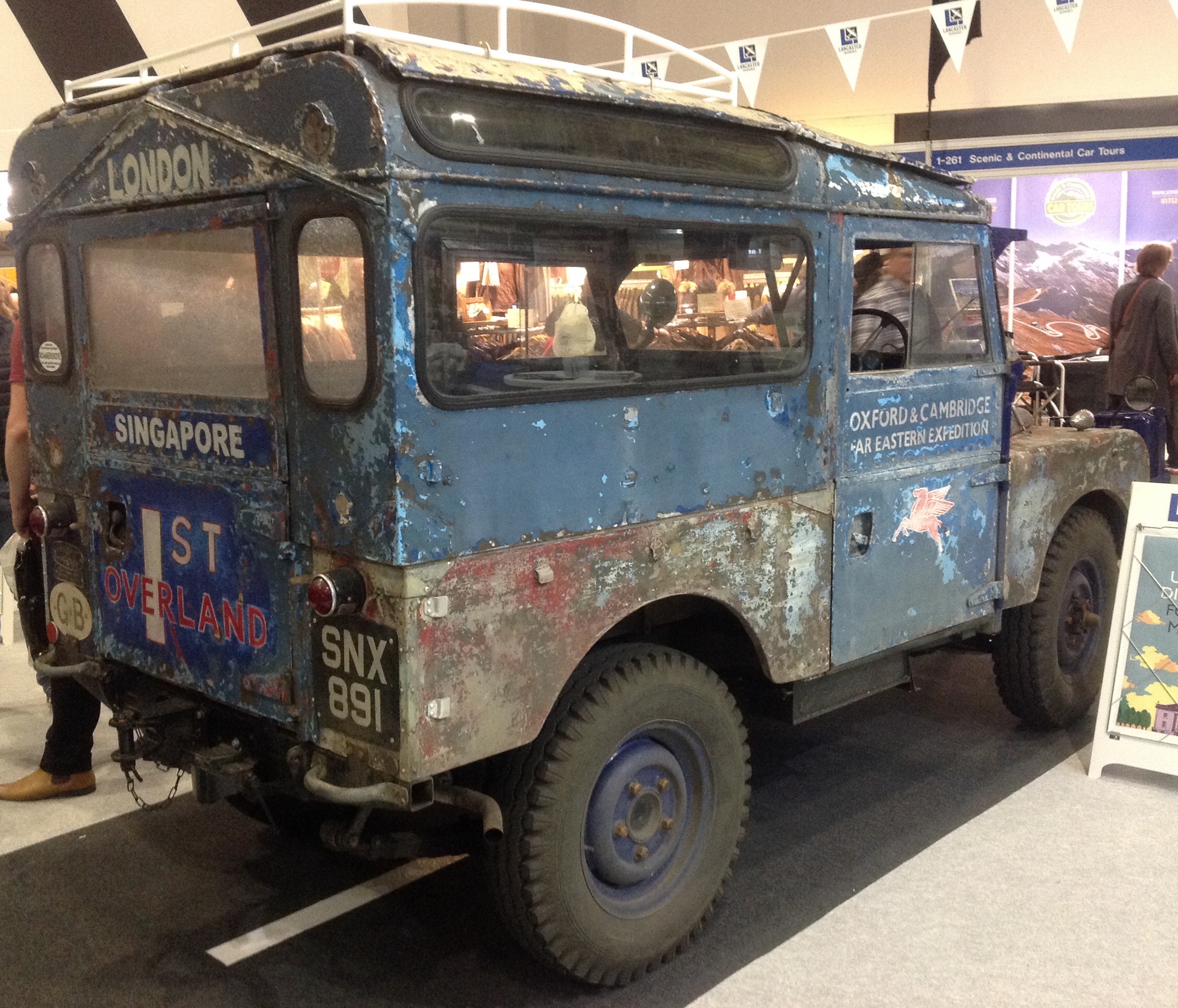
The vehicles—nicknamed Oxford and Cambridge—were Series I 86-inch Land Rover station wagons. Their four-cylinder petrol engines, four-wheel drive, and low-range gearing made them capable, but they were small machines to ask so much of.
They carried the fuel, tools, recovery equipment, camera gear, and personal supplies needed to keep moving. Every item took up space. Every extra pound mattered. Every breakdown meant another problem to solve without assuming outside help was coming.
That’s the part modern vehicle travelers will recognize immediately. A well-equipped truck is comforting until something breaks beyond the reach of a parts counter. Then the real expedition begins: diagnosis, improvisation, teamwork, and deciding whether to keep going.
We should resist romanticizing every hardship. Mechanical trouble in remote country isn’t automatically fun, and not knowing whether a crossing is possible isn’t a charming inconvenience. It’s exhausting, consequential work. That is precisely why the achievement resonates.
The Film Nearly Had Its Own Impossible Journey
There’s another reason this story survives: the team brought cameras.
Think about what that meant in 1955. The expedition was filmed in color on equipment with limited shooting time. There was no digital screen to check whether a moment had been captured properly. Film had to be sent back to Britain for processing while the vehicles continued east.
The filmmakers were trying to document a journey they could barely predict, knowing that the best—and most dangerous—moments wouldn’t wait for a second take.
Decades later, producer Graeme Aldous helped restore and edit the surviving footage, adding interviews and commentary. The result offers something a modern recreation cannot: a view of the roads, vehicles, crossings, and people as they actually appeared during the expedition.
The Royal Television Society tells the story of the film’s restoration.
They Made It. But That’s Not the Best Part of the Story.
On March 6, 1956, the expedition arrived in Singapore. Six men and two Land Rovers had completed a journey that had begun as an almost implausible idea over an atlas.
The achievement isn’t simply the distance. It’s the accumulation of uncertain decisions: whether the next road was passable, whether the vehicles could take another beating, whether the team could solve one more unexpected problem and still have enough energy to tackle the next.
First Overland is compelling because the outcome wasn’t guaranteed when they turned the ignition keys in London. Knowing that they eventually succeeded doesn’t erase the uncertainty they faced along the way.
How to Watch First Overland
Watch an available expedition video: Curbside Classic’s First Overland feature embeds a video, also linked on YouTube. We have not verified that this is the complete restored documentary.
Look for the restored documentary: The Royal Television Society identifies Teeafit Sound & Vision as a DVD producer’s source, but current purchasing availability remains unconfirmed.
Continue the story: The Last Overland follows a modern Singapore-to-London return expedition, with four episodes linked from the official site. It is a separate series, not the original documentary.
Viewing leads checked November 1, 2026; availability may change.
The Book Takes You Inside the Expedition
Film shows the terrain. Tim Slessor’s book, First Overland: London–Singapore by Land Rover, offers a fuller account of the planning, personalities, and problems behind the journey. For anyone who has ever looked at a map and wondered whether a seemingly impossible route might work, it’s a natural companion.
Find First Overland on Amazon. As an Amazon Associate, we earn from qualifying purchases.
One Land Rover Got a Second Chance
The story didn’t end in Singapore. Decades later, Oxford was recovered from Saint Helena and returned to working condition. In 2019, the same vehicle took part in The Last Overland, a Singapore-to-London expedition associated with filmmaker Alex Bescoby.
One battered old Land Rover connects two eras of adventure. The technology, borders, and expectations changed dramatically. The appeal of setting out toward somewhere distant—and not knowing exactly what the road will demand—didn’t.
Why This Story Still Matters
It’s easy to think of overlanding as a vehicle build, a gear list, or a destination pinned on a digital map. First Overland reminds us of something more fundamental: adventure begins when the plan stops being reliable and the people involved have to figure out what comes next.
You don’t need to drive from London to Singapore to understand that feeling. But watching six young men attempt it in 1955 might permanently change the way you look at the next unknown road.
For more expedition reading, explore our Classic Overlanding Books guide.