
Kelvin Kent’s expedition photographs show a helicopter bringing in replacement differentials. In his account of the crossing, the team went through 17. It is a striking detail to carry into The Darién Conquest. The Range Rovers could enter the jungle under their own power, but keeping them moving demanded far more than the vehicles themselves.
The British Trans-Americas Expedition set out to connect Alaska with the southern end of South America in the early 1970s. The Darién, between Panama and Colombia, stood in the way. Crossing it meant taking an expedition into a place where the road they needed did not exist.
The Darién Conquest film imagery, via Silodrome.
Explore all ten expedition documentaries in our viewing guide.
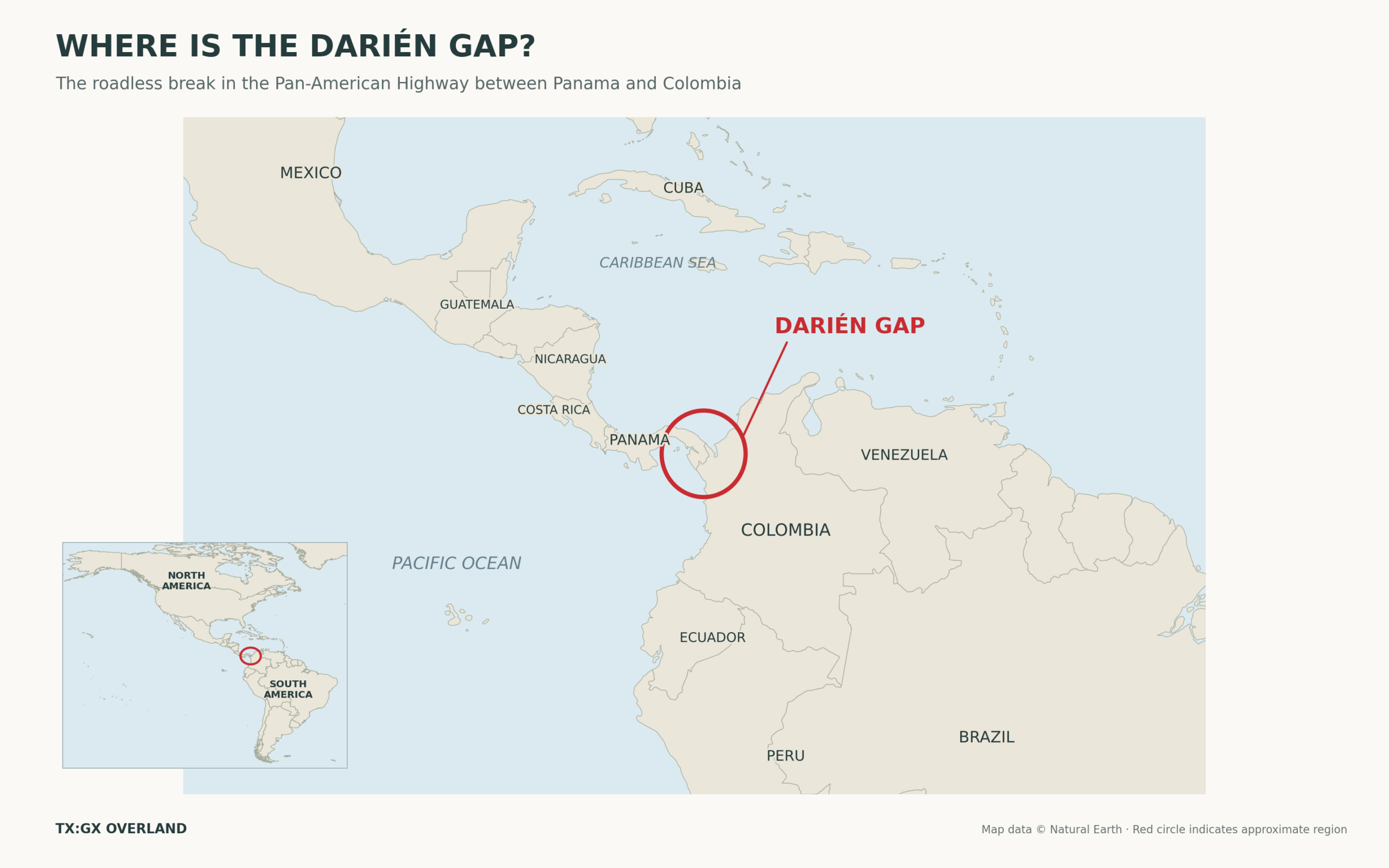
The Darién Gap is a region of dense rainforest, swamp and rivers between Panama and Colombia where the Pan-American Highway breaks off. There is no established road connecting the highway on either side. For the vehicle expeditions shown in these films, crossing meant creating a passage through the jungle itself. Teams had to scout ahead, cut vegetation with machetes and chainsaws, clear obstacles and work out how to move heavy vehicles across mud and water. Before a driver could advance, someone often had to make room for the vehicle to pass.
An idea becomes an undertaking
John Blashford-Snell led the expedition, with Kent as his deputy. In Blashford-Snell’s published recollection, the proposal began with a conversation about the missing link in the Pan-American Highway. Could a team get through it? The question grew into an operation involving military personnel, scientists and international support.
Two Range Rovers became the vehicles at the center of the attempt, with a short-wheelbase Land Rover helping find the route ahead. The film gives a recognizable shape to the ambition. Most of us can picture driving a Range Rover. Then the jungle starts asking things of it that no showroom demonstration could prepare you to understand.
Everything has to get there
Kent describes engineers, reconnaissance parties, communications teams, pack animals and an aircraft. Supplies also moved by local canoe. The route had to serve people who needed food, fuel, medical support and somewhere to work, as well as the vehicles trying to advance.
That makes the film absorbing even when progress is slow. Every obstacle creates another job. A river has to be crossed, a route has to be found, a broken part has to reach the people who can replace it. Getting one vehicle ahead is only part of getting the expedition through.
The weight of the next mile
There is something especially compelling about seeing a familiar machine in a place where it looks so out of its depth. Its weight becomes a problem. A bank becomes an engineering task. Ground that seems manageable on foot can demand hours of work before a vehicle can follow.
The attraction lies in watching people commit themselves to solving those problems. You begin to appreciate the relief that must accompany each small piece of progress, because the next obstacle is waiting just beyond it.
Why watch it
Choose this for the ambition and the machinery, then give the slower work your attention. The engineering and supply effort reveal what it took to carry a continent-spanning idea through the jungle.
The title belongs to its era, as does the expedition’s outlook. Local knowledge and Panamanian and Colombian assistance helped make the crossing possible. Those contributions are part of the story you are watching, alongside the British team and its vehicles.
How to watch
Watch the film through Silodrome’s embedded player. Its feature credits permission from British Forces Broadcasting Service. Blashford-Snell’s and Kent’s accounts, linked below, add context to the operation shown on screen.
Viewing information checked November 8, 2026. Follow the linked viewing page for current availability.
Keep exploring
Follow the jungle crossing with a change of landscape in Expedition: Greenland, where three trucks take on the ice sheet. For expedition reading, Tim Slessor’s First Overland recounts the original London-to-Singapore journey. As an Amazon Associate, we earn from qualifying purchases.
Sources and further reading
Blashford-Snell’s expedition account · Kelvin Kent’s expedition account