
A cold night at camp is usually lost from the bottom up. The sleeping bag gets blamed, but the uninsulated mattress underneath it may be letting the ground pull heat away all night. Then the propane heater gets the shopping attention when the better first move is often a warmer pad, a bag rating you understand and one backup that does not depend on combustion.
This guide builds that system in the order that matters. It complements our five tent-heater options; it does not repeat them. Get the bed right first, then decide whether your camp needs active heat at all.
The quick answer
| Priority | What to check | Why it matters |
|---|---|---|
| 1. Ground insulation | Pad R-value | A thick mattress can still sleep cold if it lacks insulation. |
| 2. Bag rating | ISO Comfort and Lower Limit | The number in the model name is not always the number that matches your body. |
| 3. Dry layers | Base layer, socks, hat | Dry sleep clothing protects the insulation already around you. |
| 4. Targeted heat | Electric blanket or hot-water bottle | Warm the sleeper instead of trying to heat every cubic foot of tent. |
| 5. Failure plan | Warmth without battery or flame | The night still works if a cord, fuel pump or power station quits. |
Start underneath: choose the R-value before the thickness
R-value measures how strongly a sleeping pad resists heat flow. Higher is warmer, and current ASTM-tested values let you compare brands on the same basis. REI’s current guidance puts R-values from 4.0 to 5.4 in the cold-weather range and 5.5 or higher in the extreme-cold range. It also notes that standardized sleeping-bag tests assume an insulated pad, so a warm bag cannot fully rescue a cold mattress.
For vehicle camping, the EXPED MegaMat is the comfort-first example. Its 4-inch foam-and-air construction carries an R-value of 8.1. The current single-pad sizes run from 4 pounds 9 ounces to 5 pounds 11.5 ounces. That is easy to justify in a GX, Jeep or truck when a good night’s sleep matters more than a tiny stuff sack.
The Therm-a-Rest NeoAir XTherm NXT makes the opposite trade. It also offers serious insulation—R 7.3—but the Regular weighs 15.5 ounces and packs to roughly 9 by 4.5 inches. Choose it when cargo space is tight, when the same pad will be carried away from the vehicle, or when a compact backup bed belongs in the truck.
One useful low-cost move is to place a closed-cell foam pad beneath an inflatable pad. R-values are additive, so the second pad adds insulation, protects the inflatable from the ground and still gives you something to sleep on if the air pad fails.
Read the bag label past the big number
ISO Comfort is the more useful number for a person who sleeps cold. ISO Lower Limit is the lower temperature at which a warm sleeper may avoid becoming excessively cold; it is not a promise of relaxed comfort. Extreme is a survival rating and should not be used to plan a trip.
The NEMO Disco 15 shows why the distinction matters. NEMO lists the Regular men’s version at 27°F ISO Comfort and 16°F ISO Limit. A cold sleeper considering a 25-degree forecast should pay attention to the 27-degree Comfort number, not assume the “15” in the product name guarantees a warm night.
Leave margin for wind, humidity, fatigue, damp insulation and the fact that people sleep differently. Try the complete setup close to home before asking it to carry an isolated winter weekend.
Add electric top heat when power is already part of camp
The Ignik Topside Heated Blanket puts heat directly over one sleeper instead of warming the tent air. Ignik lists a 48-watt maximum output and a 12-volt, 4-amp requirement. REI lists it at 72 by 52 inches and 3 pounds 9.6 ounces. It comes with a 12-volt vehicle adapter, but the practical overnight source is a power station with enough capacity and a socket that can supply the required current.
Do the battery math before the trip. A 250Wh power station contains about 5.2 hours of energy at a continuous 48W draw; a 500Wh station contains about 10.4 hours. Actual runtime will be lower or higher depending on conversion losses, heat setting, controller cycling, battery temperature and the usable capacity the manufacturer allows. Ignik recommends a 500Wh source for its heated-sleep products, while REI lists 250Wh as the minimum recommendation for this blanket.
A heated blanket is an addition to the sleep system, not the system itself. Keep the insulated pad and temperature-appropriate bag capable of carrying the night if the battery empties at 3 a.m.
Keep one warm option that cannot run out of electrons
A properly closed hot-water bottle placed in the bag before bedtime is simple targeted heat. Chemical hand warmers can serve as another compact backup when used according to their instructions and kept away from bare skin. Neither replaces a real pad or bag, but both still work when a cable breaks or a power station refuses a cold-weather startup.
Dry sleep clothing matters just as much. Change out of damp trail or camp layers, use dry socks and keep a hat close. For the outer layer that gets you through setup and the first cold morning, our five fall jackets guide covers packable insulation, fleece, soft-shell and rain options.
Where fuel heaters fit—and where they do not
Ducted diesel, gasoline and externally vented propane furnaces can make a vehicle-supported basecamp much more comfortable because combustion stays outside and warm air is routed into the shelter. Our tent-heater buying guide compares those systems with electric heat pumps and hot-tent stoves.
An unvented radiant propane heater is a different tool. Mr. Heater markets the Portable Buddy MH9BX for large tents and lists 4,000- and 9,000-BTU settings, an oxygen-depletion sensor and a tip-over shutoff. The owner’s manual still requires adequate combustion and ventilation air. The U.S. Consumer Product Safety Commission says never use fuel-burning portable heaters while sleeping in enclosed tents, campers or vehicles. If you choose this type of heater, use it only in a manufacturer-approved setup while awake, follow the heater and shelter instructions, preserve clearances and ventilation, and shut it down before sleep.
As an Amazon Associate, TX:GX Overland earns from qualifying purchases.
A practical cold-night loadout
- Insulated pad matched to the forecast, with a repair kit
- Sleeping bag selected by ISO Comfort or Lower Limit—not only the model name
- Dry base layer, socks and hat reserved for sleep
- Electric blanket only when the power plan supports a full night
- Hot-water bottle or chemical warmers as a no-battery backup
- Battery carbon-monoxide alarm whenever combustion equipment is part of camp
- Bedding that remains adequate if every active heat source stops
Build from the ground up. The pad slows heat loss, the bag traps what your body produces, dry layers keep the insulation working and targeted heat buys comfort without turning the tent into a mechanical project. That is the sleep system that makes a cold forecast feel like an invitation instead of a reason to cancel.
Research note: These are research-based recommendations, not claims of TX:GX field testing. Product specifications and safety guidance were checked November 16, 2026. Prices and availability can change.
Sources: REI sleeping-pad and R-value guide; NEMO ISO rating guide; EXPED MegaMat specifications; Therm-a-Rest XTherm NXT specifications; NEMO Disco specifications; Ignik Topside specifications; Mr. Heater MH9BX specifications and owner’s manual; CPSC camping-heater guidance; National Park Service camping checklist.
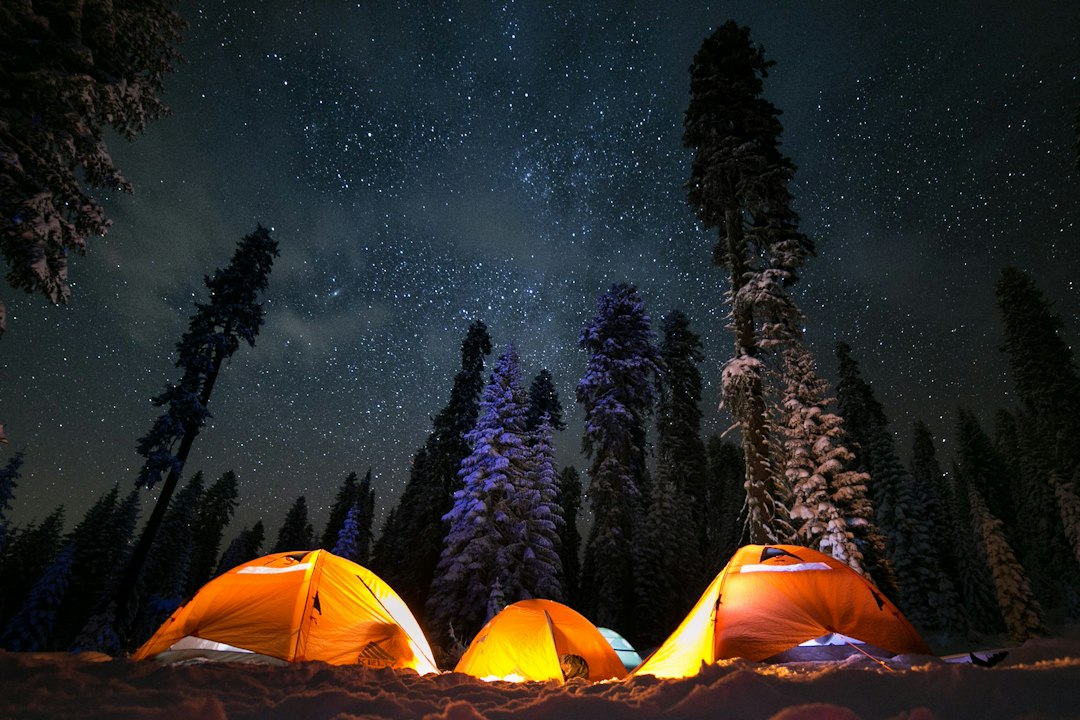
Photo credits: Featured image by Sebastian Marx / Unsplash. Supporting snow-camping image by Cameron Vaughan / Unsplash. Both are authentic illustrative winter-camping photographs used under the Unsplash License; neither depicts a reviewed product or a Texas campsite.