
An old Land Cruiser can be a brilliant overland platform. It can also be a very expensive way to discover that reputation does not cancel age, rust, deferred maintenance or bad modifications.
For U.S. buyers, the choice usually comes down to three full-size generations: the 80 Series sold here for 1991–1997, the 100 Series for 1998–2007 and the 200 Series for 2008–2021. All three are body-on-frame, full-time four-wheel-drive wagons with low range. Beyond that, they have very different personalities.
The short answer: buy an 80 for technical trail work, a 100 for the best all-around value, and a 200 for family travel, towing and long highway miles. Then let condition—not the badge—decide which actual truck you buy.
The 30-second comparison
| Generation | U.S. model years | Basic layout | Best for | Main tradeoff |
|---|---|---|---|---|
| 80 Series | 1991–1997 | Solid front and rear axles; inline-six | Technical trails, simple builds, classic Land Cruiser feel | Oldest, slowest and most likely to need age-related rehabilitation |
| 100 Series | 1998–2007 | Independent front, solid rear; 4.7-liter V8 | Balanced travel build, daily use and moderate trails | Less front-end articulation than an 80; still old enough to demand careful inspection |
| 200 Series | 2008–2021 | Independent front, solid rear; 5.7-liter V8 | Family travel, towing and high-speed distance | Heaviest, thirstiest and most complex to modify or repair |
Toyota’s own history describes the same progression: the 80 added coil springs and full-time four-wheel drive, the 100 introduced independent front suspension and a V8, and the 200 combined a stronger platform with modern chassis electronics. That evolution made each generation easier to live with—but not automatically better for every trail.
80 Series: buy it for the hardware, not the legend
The 80 is the one enthusiasts romanticize, and there is a reason. It uses solid axles at both ends, coil springs and a locking center differential. Some later trucks were also ordered with front and rear differential locks, but do not assume every 80 has them. Verify the actual switches, axle hardware and operation.
U.S. 1991–1992 trucks used the 4.0-liter 3F-E inline-six with 155 horsepower. For 1993, Toyota installed the 4.5-liter 1FZ-FE with 212 horsepower and 275 pound-feet of torque. That later engine is the more useful starting point for a loaded travel truck, although no stock 80 feels quick by modern standards.
An 80 makes sense if your trips include ledges, cross-axle terrain and slow technical work where axle articulation matters more than quiet cruising. Its simple, proven layout also gives builders a huge base of suspension, armor and driveline knowledge.
But every U.S. 80 is now nearly three decades old. The correct buying question is not “Does it run?” It is “How much restoration is hiding behind the modifications?” Inspect frame and body corrosion, cooling-system condition, steering-knuckle leakage, axle and driveshaft play, brake condition, wiring quality and evidence of overheating. Check that every locker engages. A heavily modified truck with no receipts can be a worse buy than a stock example with faded paint and documented maintenance.
Choose the 80 if: difficult trails are the point of the trip, you accept slower highway travel and you have the budget—or ability—to rehabilitate an old vehicle properly.
100 Series: the smartest all-around choice for most buyers
The 100 replaced the 80’s solid front axle with double-wishbone independent front suspension and introduced Toyota’s 4.7-liter 2UZ-FE V8. Early U.S. examples produced 230 horsepower; output rose to 275 horsepower for 2006. Early trucks used a four-speed automatic, while later examples moved to a five-speed.
Independent front suspension gives up some articulation and simplicity, but the payoff is a calmer, more precise truck on pavement and washboard. The 100 is smaller and less electronically layered than a 200, yet far easier to use every day than an 80. That middle position is why it is the best answer for many buyers.
For a Texas-to-Colorado trip, a forest-road weekend or a build that still has to handle school, work and highway miles, the 100 usually makes the most sense. It has enough power for a moderate load, excellent parts and aftermarket support, a durable rear axle and a cabin that still feels like a comfortable SUV rather than an expedition appliance.
Inspection should concentrate on service history and the expensive wear points of an aging independent-front-suspension truck. Confirm timing-belt and water-pump history, inspect control-arm bushings, ball joints, CV boots, steering components, wheel bearings and driveline play, and look for cooling-system leaks or improvised electrical work. On any lifted example, check alignment, tire wear, CV angles and whether the suspension parts work together as a system.
Choose the 100 if: you want one truck to commute, carry a family, cover long distances and still handle real backcountry travel without paying 200-Series money.
200 Series: the best travel vehicle—and the most vehicle to manage
The 200 moved the Land Cruiser firmly into modern full-size SUV territory. U.S. trucks use a 5.7-liter V8 rated at 381 horsepower and 401 pound-feet of torque. They retain full-time four-wheel drive, a two-speed transfer case and a locking center differential, while systems such as KDSS and Crawl Control add capability without turning the truck into a harsh trail special.
The 2016 update paired the V8 with an eight-speed automatic, replacing the earlier six-speed, and later trucks were rated to tow up to 8,100 pounds when properly equipped. The real advantage is not a single specification. It is how effortlessly a 200 carries people, fuel and camping gear across several states.
That capability comes with mass, width, fuel consumption and complexity. A 200 is harder to place on narrow trails than an 80 or 100, and accessories add weight quickly. Before ordering armor, drawers, a roof tent and a larger spare, weigh the truck with the normal passengers and cargo. Published payload varies by year and configuration; the certification label on the driver’s doorjamb governs the actual vehicle.
During inspection, check KDSS components and hydraulic lines for leaks, verify every four-wheel-drive and driver-assistance function, inspect the cooling and charging systems, test all electrical equipment and review maintenance records rather than trusting a clean interior. Large tires and suspension changes can be expensive to correct if the original build ignored alignment, gearing, braking and weight.
Choose the 200 if: the truck will carry a family, tow, cover long highway distances or serve as a comfortable travel platform—and your budget includes fuel, tires, maintenance and weight-conscious modifications.
What matters more than the generation
The best Land Cruiser is the best-documented, least-abused example you can afford after reserving money for baseline maintenance. A cheap purchase price does not make a cheap build.
Before buying any of the three:
- Pay for an independent pre-purchase inspection. Use a shop that understands older Toyota four-wheel drives, not only a general used-car checklist.
- Inspect the underside before the accessories. Rust, collision repair, fluid leaks and hacked wiring matter more than bumpers and lights.
- Verify the VIN and open recalls. Use the NHTSA recall lookup. NHTSA notes that VIN results do not show every older or already-completed campaign, so keep the service records too.
- Demand cold-start and hot-running tests. Watch temperature, charging voltage, oil pressure behavior, smoke and leaks. Drive it at neighborhood and highway speeds.
- Test the four-wheel-drive hardware. Engage low range and the center lock; test axle lockers if fitted. Confirm warning lights behave correctly.
- Audit every modification. Ask who installed it, why it was installed and whether the supporting changes—gearing, brakes, alignment, cooling and wiring—were completed.
- Price the first year before negotiating. Include tires, fluids, belts, hoses, brakes, suspension wear, battery, recovery points and any overdue major service.
The TX:GX verdict
The 80 is the most trail-focused platform, but only if you genuinely need its solid front axle and accept the restoration burden. The 200 is the best long-distance family vehicle and tow platform, but it is costly to feed and easy to overload with accessories.
For most buyers building one vehicle for Texas weekends and longer regional trips, the 100 Series is the sweet spot. It is old enough to remain relatively straightforward, modern enough to drive comfortably every day and capable enough for the trails most travelers actually use.
Do not buy the generation you admire most online. Buy the cleanest platform that matches the hardest 10 percent of your real trips.
A useful first upgrade
Before armor or roof weight, make sure the truck can air down and recover pressure reliably. See our Smittybilt 2781 portable air-compressor review for a practical starting point. That review contains affiliate links; TX:GX may earn a commission from qualifying purchases at no additional cost to you.
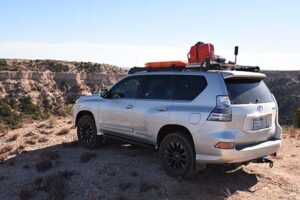
Reporting note: This guide covers U.S.-market Toyota Land Cruisers only. Engines, transmissions and equipment differ in other markets. Specifications and available equipment were checked against Toyota’s official Land Cruiser history and U.S. newsroom archives on October 28, 2026. Used-vehicle condition varies; this is a selection and inspection guide, not a substitute for a professional pre-purchase inspection. Featured image: Tennen-Gas / Wikimedia Commons, CC BY-SA 3.0; authentic 200 Series photograph, unchanged.